
3 hours

Insurance Often Pays (Deductible Co-Insurance Will Apply)
$8900 if no insurance coverage

1-2 Weeks Basic
4 Weeks Full
Our Approach to Insurance Breast Reduction
Medically reviewed by Christopher J. Ewart, MD and Michael S. Tarakji, MD, Board-Certified Plastic Surgeons — Updated August 2026
Risks and How We Minimize Them
Breast reduction has among the highest satisfaction rates in plastic surgery — and honest trade-offs. The main ones are scarring (the anchor pattern is the price of reshaping; our scar-care protocol starts at 3-4 weeks), temporary nipple or breast numbness (resolves for most patients within 6-12 months), possible impact on breastfeeding (tell your surgeon if it matters — technique choice preserves the best odds), and standard wound-healing risks, where nicotine is the biggest controllable factor (minimum 2 weeks nicotine-free required, ideally 4-6 weeks). Every procedure is performed in our QUAD A accredited surgical facility.
Paying out of pocket instead? See our cosmetic breast reduction page with transparent pricing.
Common Concerns
- My breast are too large
- I have back, neck and /or shoulder pain
- I have bra strap shoulder grooves
- My breasts sag and my nipples point downward
- My breasts aren’t symmetrical
- I have rashes under my breasts
- I can’t exercise due to my breast size
Frequently Asked Questions
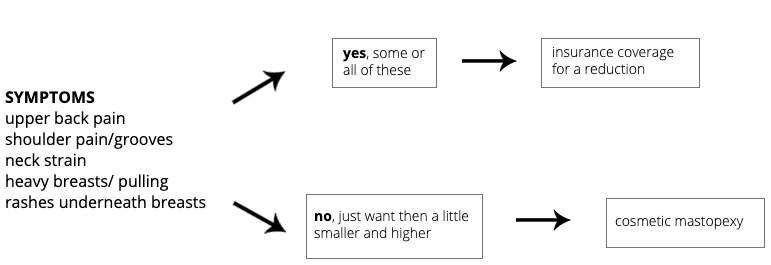
Do I need a breast reduction?
Most patients who benefit from a breast reduction are wearing DD or larger bras with many patients wearing DDD, F, G, and more.
Is a breast lift included with every breast reduction?
YES. When we perform a breast reduction, we also perform a breast lift to bring the nipples back to a normal position, relieve the pull from sagging, and reduce the rubbing and overlap of breast skin on the upper abdomen.
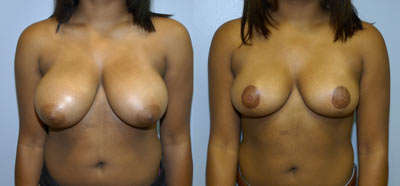
Reduction and Lift
What size will I go down to?
- CURRENT CUP SIZE — D, DD, DDD, E, F, G, and Up
- FINAL CUP SIZE — Most patients average a 2-3 cup size difference but it can vary with every patient. We remove enough breast tissue to help relieve your symptoms, but leave enough to prove a good breast shape and fit for your frame size. C cup is the most common size. At Augusta Plastic Surgery, or surgeons will try to match your preference the best we can.
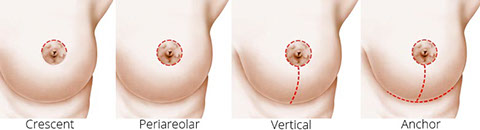
What types of incisions are made for a Mastopexy?
- Crescent Incision — The least common incision since very little lift can be obtained. It does slightly lift the nipple position and the implants can be placed through the same location if needed.
- Periareolar (Donut) Incision — This incision is hidden along the color change of the areola. The scar can be very discreet in some patients. It can provide several centimeters of lifting to the nipple and also reduce the excess skin of the breast with a small scar. Implants can be placed through this incision as well.
- Vertical (Lollipop) Incision — Probably the most common incision since more lifting can be performed with this incision and more sagging breast skin can be removed. Commonly performed with implant placement for more upper pole fullness.
- Anchor Incision — The most traditional scar that can remove the maximum amount of skin and provide the most lifting if needed. Implants can also be used and placed through the same incisions.
Surgery Details
- Anesthesia:
- General
- Location:
- Augusta Plastic Surgery Center located at 569 Furys Ferry Rd. in Martinez, Georgia.
- ASC Certification:
- AAAASF
- Surgeons:
- Dr. Christopher Ewart and Dr. Michael Tarakji
Board Certified Plastic Surgeons